The Moving Image

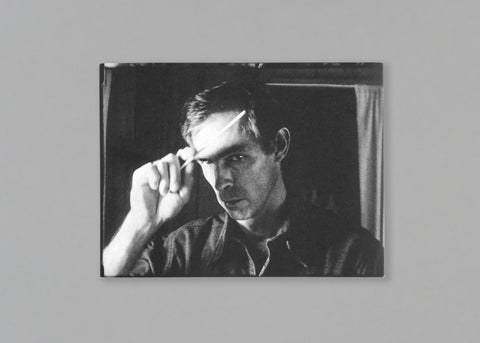
Still from Pull My Daisy


In 1959, Robert Frank made a Super 8 movie with his beatnik friends called Pull My Daisy. The first scene opens onto a Bowery loft piled with beer cans and “tortured socks” where a railroad break man, played by Larry Rivers, and a painter, played by Delphine Seyrig (of Jeanne Dielman) live. It’s the morning and Delphine Seyrig swiftly sends her son to school to learn about “geometry, and astromomology, and pipoliology, and homologies.” Meanwhile, Allen Ginsburg and Gregory Corso crash the apartment to smoke, play the flute, and recite the poetry of their “secret scatological thought.” Upon the arrival of a distinguished bishop, the poets prove constitutionally incapable of feigning reverence. Squalor never looked so good.

 The film is beautiful, not only because it records a lost moment of New York bohemian culture, but because it’s shot through Robert Frank’s eyes. As he got older, Frank increasingly saw himself as a filmmaker, and sometimes even printed his film stills as photographs. “You can’t express what I want to express in stills,” he once said. “In stills you are really an observer. In film you come much closer, by the nature of the medium, to being inside what you are filming.”

How do photographers see film? And, conversely, how do filmmakers see photography? Below are a few books from the shop that, in some way, live between the two mediums.
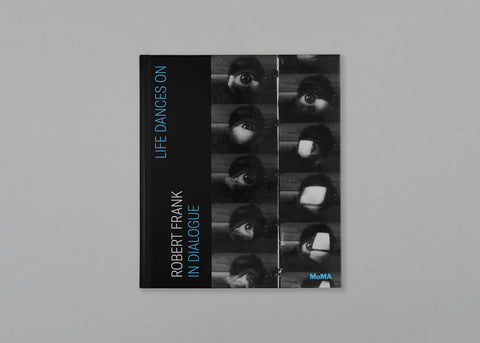

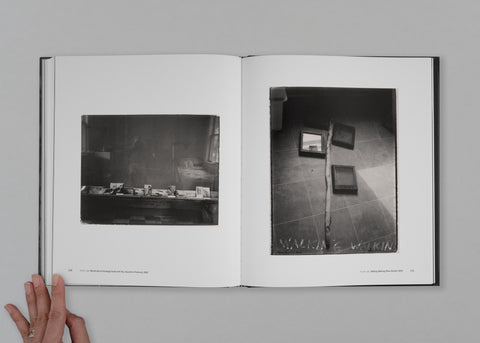
Life Dances On: Robert Frank in Dialogue

Robert Frank shot Super 8 and video all his life. Many of his reels and cassettes gathered dust in boxes in his Bleeker Street apartment until he died in 2019. At the initiative of Leaf and the Robert Frank Foundation, the footage was finally digitized and collaged into what they call Robert Frank’s Scrapbook Footage. 

 In curator Lucy Gallun’s essay for Life Dances On, the catalog for a magnificent 2024 MoMA exhibition on Robert Frank’s interdisciplinary sensibilities, the artist is quoted: 

“I’d like to make a film which would mingle the private aspects of my life with my work, which is public by definition… I’d like to make a photo-film and work out a dialogue between the movement of the camera and the freezing of the still image, between the present and the past, inside and outside, front and back.”

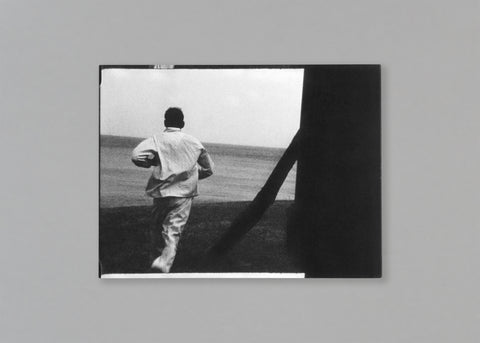
In some cases, Frank made "photo-films": movies built from still photographs. In other cases, he printed Super 8 film strips as photographs. These pictures feel somewhere outside of time. Frank often etched his film strips with dates and strange annotations that may or may not relate to what they visually represent. In one instance, the words “time and tide waits for no man” overlay a picture of the sea from his window in Nova Scotia.

Frank continues: “I would make this film in a seedy background in Cape Breton, Nova Scotia and New York…Two houses. Two countries. Two points of view. One is outside cultural life, the other right in it. One is the other’s refuge. Both are at the same time necessary and useless…. In my film— and because of the very way they float in the current of my normal life — my photographs will become pauses in its flux, breaths of fresh air, windows on another time, on other places… And of course there will be the usual stream of characters: neighbors, art dealers, lawyers, caretakers, thieves, the swindlers and the swindled, a few friends as well, not forgetting the unexpected guest. All that in 30 minutes… I’d like to make that into a film."

Martha Naranjo Sandoval. Small Death

Unbeknownst to many, Martha Naranjo Sandoval’s first life was as a filmmaker.  She might still be a filmmaker at heart, at least when it comes to book editing. Her debut book with MACK, Small Death, which was nominated for a 2025 Paris Photo – Aperture PhotoBook Award­, brings a feeling for rhythm and movement to the book form. In a recent conversation, Martha attested to her admiration for the pioneering avant-garde filmmaker Sergei Eisenstein, and in particular, his 1938 essay “Word and Image.” In it, he describes montage — a technique of combining elements to form new associations — as resisting static meaning. "A work of art, understood dynamically, is just this process of arranging images in the feelings and mind of the spectator...It has to arise, to unfold before the senses of the spectator.”

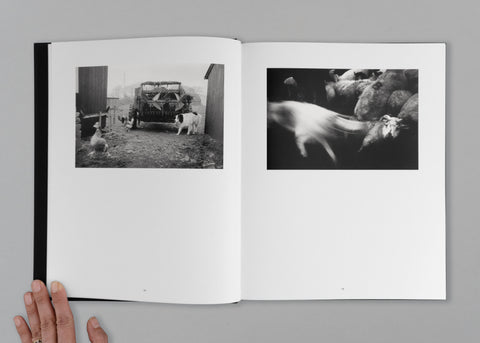
Perhaps for this reason, Naranjo Sandoval insists that she sequenced her book with no concrete narrative in mind, and no text to help ground the viewer. Looking at her book is more like poring through hundreds of contact sheets, imagining how one picture leads to the next, and how it might add up to one complex and incoherent life.

Yorgos Lanthimos. I shall sing these songs beautifully

While shot on the set of Kinds of Kindness, Lanthimos’s debut book with MACK is its own creature. The photographs, for one, don’t document the process of shooting, nor do they follow the film’s plot. Take the photos outside of the context of the film, and they suggest new narratives with Emma Stone, incidentally, as its protagonist. Uncanny and surreal, the book heightens the fact that any photobook, even those claiming some status of documentary photography, are inevitably fiction.

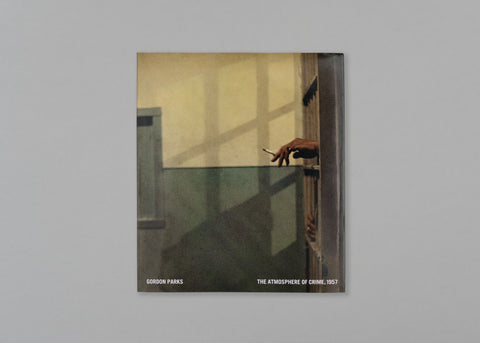
Gordon Parks. The Atmosphere of Crime

Gordon Parks participated in what is arguably the most enduring document of Depression-era America; that is, the FSA’s Information Division led by Roy Stryker, an ambitious endeavor to photograph some of the country’s most marginalized rural communities. After the Depression, Parks widened his gamut beyond documentary photography to explore different forms of narrative storytelling. In 1990, for example, he composed the music and libretto to Martin, a ballet about the life of Dr. Martin Luther King, Jr. In 1969, he directed and scored an autobiographical film called The Learning Tree (1969) . Not only was it Parks's directorial debut. It was also the first major studio film by a Black director in the US.

 One difference between Parks the film director and Parks the documentary photographer is a sense of creative autonomy. Beholden to editors and the notoriously imperious Roy Stryker, Parks was sometimes forced to relinquish control of the narrative behind his photos. Such was the fate of his 1957 photo assignment with LIFE Magazine about rising crime rates in the country, which the magazine’s leadership attributed to “fiends and sadists and desperados.” The writer Robert Wallace penned an accompanying article that largely bolstered the magazine’s alarmist views by justifying punitive force for the sake of public safety. Meanwhile, Parks’s photographs, though full of drama and cinematic pathos, exposed a racialized system in which law enforcement is nearly always white and justice is beside the point. Atmosphere of Crime, published by Steidl, is special in that it reclaims Parks’s original photographic vision and allows the work to live without Wallace’s intervention.

A few years ago, Peter Kunhardt, Jr, the director of The Gordon Parks Foundation, was quoted in The NYT saying that, “Parks is often called a ‘Renaissance man’ because he worked in so many different media, but I like to refer to him as a humanitarian artist who used whatever medium he could to have an impact.”

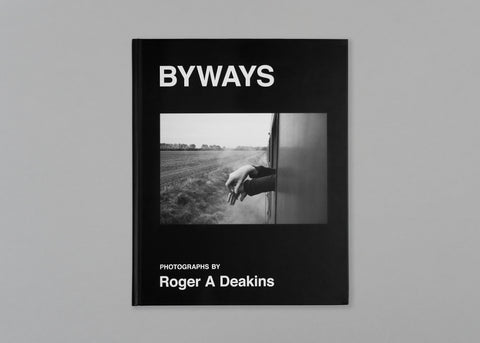
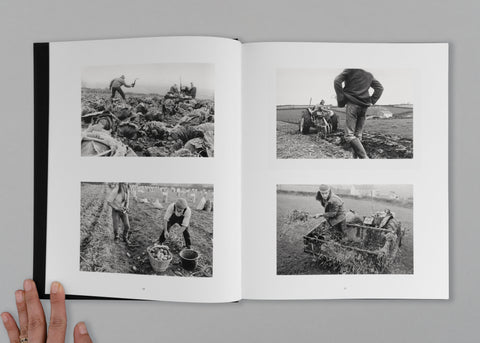
Roger Deakins. Byways

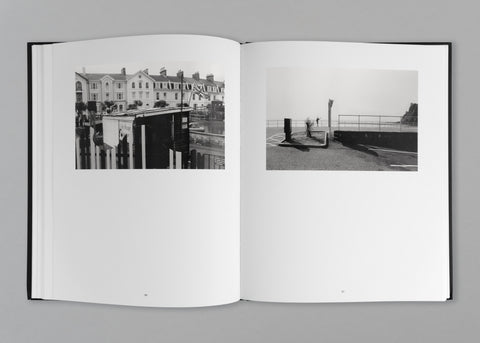
Roger Deakins is the 76-year-old British cinematographer behind Old Country for Old Men, Fargo, and Shawshank Redemption. Before entering the film industry, Deakins shot with a simple 35mm camera around southwest England where he grew up. By Ways comprises some 40 years of photographic work, which has never been publicly shown.

Lauren Oliver. Puntas Abiertas

Lauren Oliver was among the artists on our recent panel with Keisha Scarville and Martha Naranjo Sandoval on the shared language of cinema and photobooks. Her zine with Materile ediciones is called Puntas Abiertas or “split ends” and it takes the fragility of hair as a metonym for the stresses endured by the body. Endurance is one of the connective links between photography and moving image in Oliver’s work. Endurance is never captured in a single instant. It is, instead, an unfolding span of time most directly represented in a time-based medium. This, of course, shares a lot with hair struggles and the unbearable wait for it to grow out.

Gary Schneider. Salters Cottage

Salters Cottage comprises frames from a 16mm film that Gary Schneider made on Long Island in 1981 and dedicated to his mentor and friend Peter Hujar. Inspired by Jean Genet’s film Un Chant d’Amour, the book shows exchanges (some sweet and some licentious) between friends cooped up together in a cottage.

 Compiled some 40 years after the original rendezvous, the book has a structural rhythm that is quite distinct from the film. Schneider explains that he specifically wanted the book to read as “temporal portraits” that, like performance, “is about what the person brings of themselves.” That’s why we don’t see just one frame of Hujar combing his hair, but 16 of them. Thumbing through the book quickly, the pictures flash by like a flipbook. Or, taken, individually, the pictures capture 16 different expressions of Hujar during a moment of self-examination.

Robby Müller. L.A. Polaroids

Robby Müller never had a driver’s license. This is surprising given that he dedicated much of his filmic obsessions to L.A's visual landscape. Müller had a special eye for color through which he elegantly rearranged the garish and the seedy. Because of Müller, Nastassja Kinski’s red lipstick and flash of blond hair feel so devastating in Paris, Texas. And only Müller could make Screamin’ Jay Hawkins’s tux scream so wildly against the fetid green motel walls in Mystery Train.

Wim Wenders was around when Müller received his first SX-70 in 1974. A Polaroid rep quite unexpectedly approached them at the breakfast table at the Excelsior Hotel in NYC. Wenders claims it was love at first sight and that, throughout his life, “he always had his SX 70 with him wherever he went, it became like an extension of him.”

Mike Brodie. Failing

The unspoken heroine of Mike Brodie’s book with TBW Failing is a young woman named Mia Justice Smith, with whom Brodie had a brief and beautiful love affair. Smith was a gifted poet and photographer in her own right though she never received the recognition she deserved: her life was tragically cut short in 2022 due to an overdose. Cyrill Lachauer’s 2025 film SLACK, rings as a companion piece to Failing and the love affair it chronicles is simultaneously larger than life, and full of candor. After peeking into a window of Mia Justice Smith’s vision and voice, Brodie’s work never quite looks the same.